Cloud & systems
Someone to help you decide, who is not also selling you the answer
AWS, Azure or Google Cloud. On-premise or cloud. Keep maintaining the custom system or replace it. These are the decisions where being wrong costs a year — and where everyone offering an opinion has something to sell.
Architectural Clarity Before You Spend
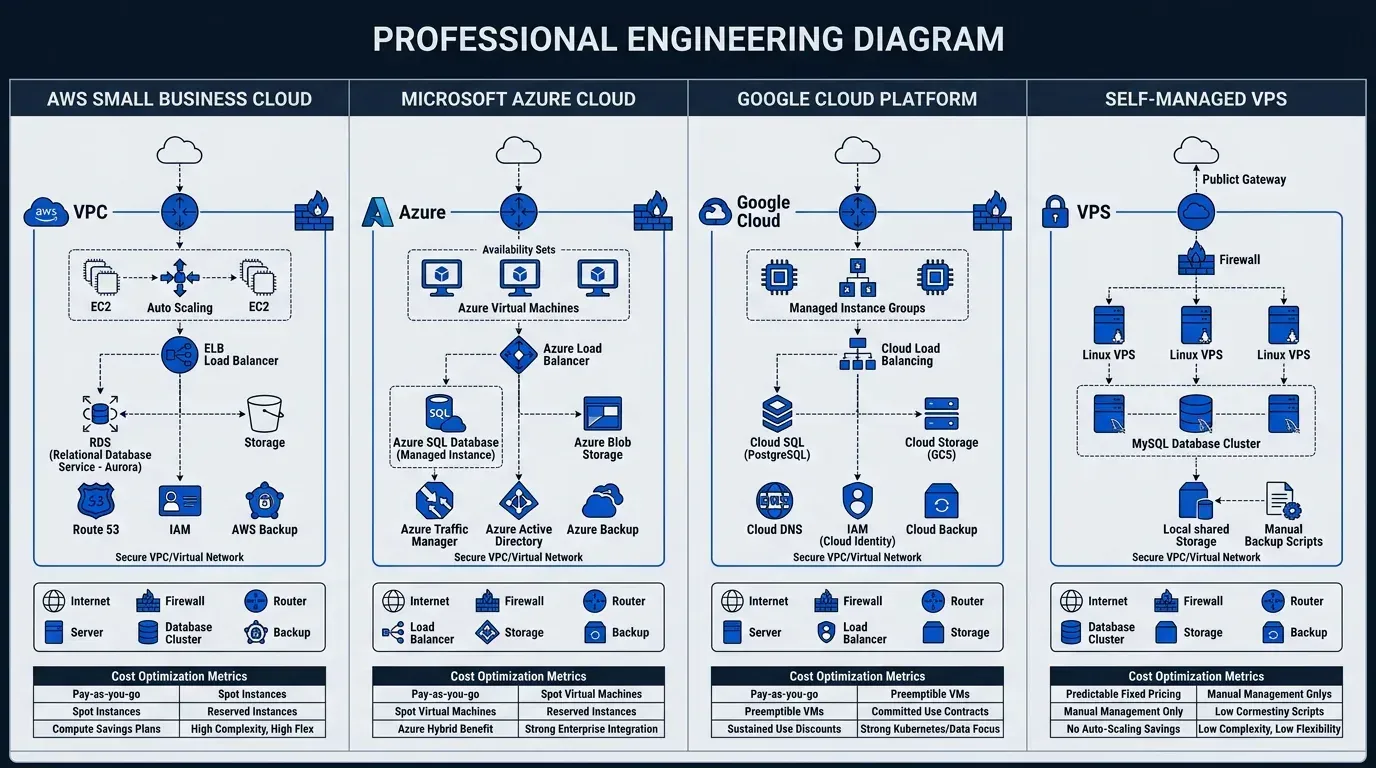
Every cloud provider presents a dazzling menu of hundreds of services. For a company under 50 employees, 90% of those services add billing complexity and engineering overhead you do not need.
We map your exact workloads against real-world operating costs across AWS, Azure, Google Cloud, and managed VPS—finding the leanest, most reliable architecture for your team.
What usually decides it
- Already on Microsoft 365, no engineers
- Azure is usually the shortest path, because the identity and billing already exist
- A developer who already knows one platform
- That platform, nearly always — familiarity beats a feature comparison
- One app, modest traffic, small team
- A managed host or VPS. The big three are frequently the expensive answer here
- It runs fine and nothing is breaking
- Stay where you are. "Because cloud" is not a reason
- Data you cannot lose and no one to run backups
- Managed services earn their premium here, whichever provider
Starting points, not answers. Every one of these changes once someone looks at what you actually run, which is the part worth paying for.
The problem with asking a vendor
Ask a hosting company whether you should move to the cloud. Ask a cloud provider which cloud. Ask the developer who built your custom system whether it is worth keeping. Every answer will be honest, and every one will be shaped by what the person answering does for a living.
For a business with no in-house technology lead, that is the whole difficulty. There is no shortage of advice — there is no way to weigh it.
Brandager sells no software, resells nothing, and takes no vendor commissions. That is not a virtue, it is the product: it is the only reason the answer is allowed to be "stay where you are", or "none of these yet", or "this is a process problem and no platform will fix it".
What we actually help decide
- Cloud provider, or none. AWS, Azure, Google Cloud, a managed host, or staying on-premise. Usually the answer turns on what your team can already operate rather than on a feature comparison.
- What a migration would really cost. Not the list price — the migration itself, the rework, the training, and the running cost once usage is real rather than projected.
- Custom software: keep or replace. When maintaining something you own stops paying for itself, and what replacing it genuinely involves.
- Off-the-shelf selection. CRM, project management, marketing automation — which category you actually need, before which product.
- Systems that do not talk to each other. The commonest finding in a small business is not a bad tool; it is four decent ones and somebody re-keying data between them.
- Whether AI belongs anywhere in this yet. Often the honest answer is not yet, and not here.
How an engagement runs
It starts with a conversation, free, and with no obligation. You describe the decision. We tell you whether it is one we can help with — and whether you need help at all, which is sometimes the answer.
If it goes further, the shape is deliberately small first: a defined piece of work with a scope and a price agreed before anything begins, so both sides find out whether the working relationship is any good before either is committed to a long one.
What you get is a recommendation with the reasoning attached, the options that were rejected and why, and what it should cost. Not a slide deck.
When you do not need us
Worth saying plainly, because the alternative is finding out after you have paid.
- You have a competent technology lead and they already agree. A second opinion has value when the first is contested, not when it is settled.
- The decision is small or easily reversed. Trying a tool for a month costs less than an hour of advice about trying it.
- You want the decision made for you. We can recommend; we cannot carry the accountability for running your business.
Common questions
What does a cloud consultant for a small business actually do?
An independent cloud consultant assesses what a business already runs, what its staff can operate, and what it is likely to need next, then recommends whether to move to a cloud platform, which one, and what the move would genuinely cost — including migration, rework and training rather than the list price alone. The value of an independent one is that "do not move" is an available answer.
Which cloud provider is best for a small business — AWS, Azure or Google Cloud?
There is no single best provider for a small business. The decision usually turns on what the team can already operate, what the current stack integrates with, and the realistic near-term growth plan, rather than on a feature comparison. A business with Microsoft 365 and no engineers lands somewhere different from one already running containers. Piloting on more than one free tier is often cheaper than researching the choice.
Do you resell cloud services or take vendor commissions?
No. Brandager sells no software, resells nothing, and takes no vendor commissions. That is what makes the advice worth paying for, because it is what allows the recommendation to be "stay where you are" or "none of these yet".
How much does cloud consulting cost for a small business?
The initial conversation is free and carries no obligation. Beyond that, engagements are scoped and priced before any work begins, and a small, well-defined first piece of work is the cheapest way for both sides to find out whether a larger one makes sense. Registered non-profits and veteran-owned businesses get a free one-hour consultation and 50% off the initial engagement.
We have no technical staff at all. Is that a problem?
It is the usual situation, and it is the reason the advice has to be independent — with nobody in-house to sanity-check a vendor's claims, the vendor's framing becomes the whole decision. Recommendations are written for what your team can realistically operate, not for what would be ideal with an engineer you do not have.
Read the detail first, if you would rather
Working through one of these decisions?
Describe it and we will tell you whether we can help — and whether you need to hire anyone at all. Free, no obligation, and no software to sell you at the end of it.