11/05/2026
The Website Your AI Can't Hold Hostage
Short answer: own four things outright: the domain's registrar account, the hosting login, your content as plain files, and a backup kept somewhere other than where the site runs. Then add one rule for the AI era: every routine edit, whether a headline, a color or a photo, needs a path a person can take with no AI tool involved. If changing a headline takes a prompt, the subscription holds your website, not you.
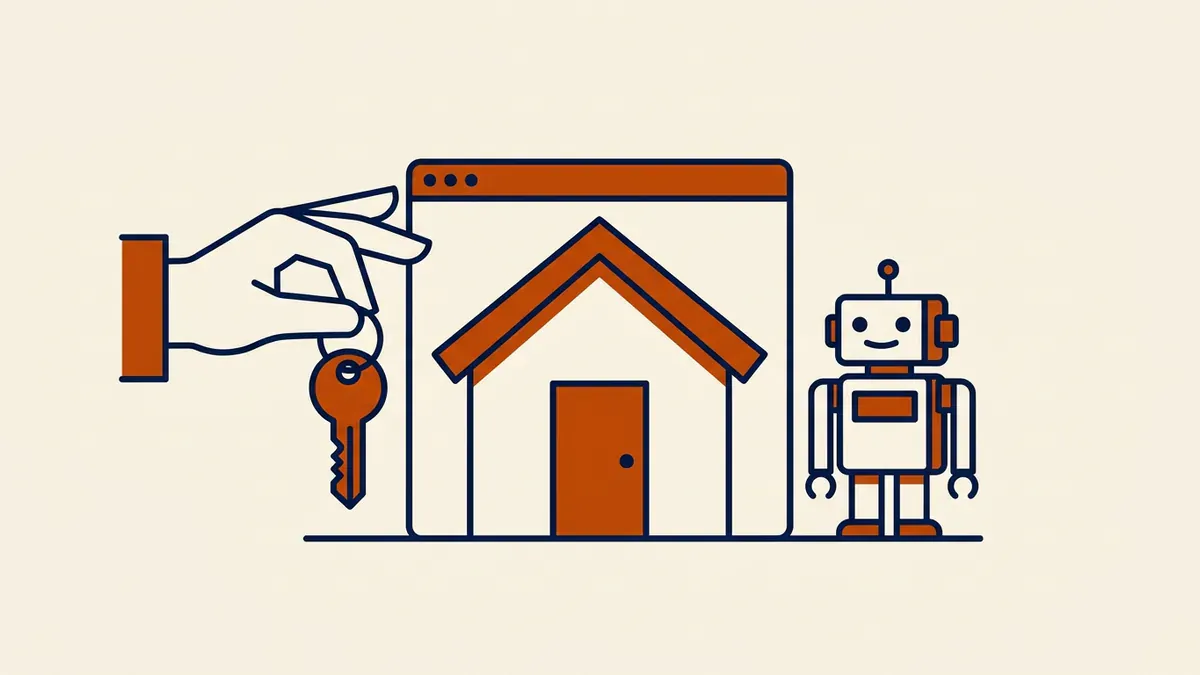
The new way to lose control of a website
The old version is familiar: a web designer registers the domain in their own name, the agency keeps the hosting login, and leaving means asking nicely.
The new version is quieter. An AI assistant or an AI site builder makes the site, and the only practical way to change anything is to ask it again. That works while the subscription is paid, the product exists and it does what you meant. When any of those stops being true, a two-minute text change becomes a project.
None of this argues against AI. It argues against an AI tool being the only way in.
The four things to own
| What | What owning it looks like | The warning sign |
|---|---|---|
| Domain registrar account | You are the registrant, the contact email is yours, and you have the login | The designer's or agency's name is in the registrant field |
| Hosting login | An account in your name, or full admin rights you can use without asking | Your only access is "a contact at the agency" |
| Content as files | Text, images and settings you can download and open with ordinary tools | The export is partial, or only in the vendor's own format |
| Backups | A copy somewhere other than the host, with its key stored somewhere else again | The backup lives in the same account it is meant to protect |
The domain matters most, because everything else can be rebuilt. If you control the name, you can point it at a new host, a new site or a new email provider. If you don't, rebuilding the site doesn't get your address back.
The domain: what ICANN says a registrant can do
ICANN's Registrants' Benefits and Responsibilities page says the registrant assumes sole responsibility for the registration and use of the domain name. It also says the registrant must keep the registrar account data current and respond to the registrar's inquiries within 15 days.
Who is listed as registrant is the whole game. ICANN's page on transferring domain names says you must be the registrant of record or the administrative contact to start a transfer. If someone else is listed, they are the one who can move it.
The rules that decide how fast you can leave
ICANN's FAQs for registrants on transferring a domain name, as fetched on 10/26/2026, set out the timing:
- The transfer code. Moving to a new registrar needs an Auth-Code (also called an EPP or transfer code). Your registrar must provide it within five calendar days of your request.
- The 60-day lock. After a change to the registrant name, organization or email address, the domain cannot move to another registrar for 60 days. Some registrars let you opt out; they don't have to.
- New and recent transfers. A registrar may refuse a transfer within 60 days of the first registration or of a previous transfer.
- Fees. A registrar may charge for a transfer, but may not refuse one because that fee is unpaid.
So if the domain sits in someone else's name today, getting it into yours is the first step, and it may start a 60-day clock. Do it before you need to move, not during an argument.
Renewal reminders go to whoever is on file
ICANN's domain name renewal and expiration FAQs say registrars must send renewal reminders about one month and one week before a domain expires, and within five days after. If the contact email is a former designer's inbox, those reminders go there.
The same page describes what happens after a deleted domain: 30 days in a redemption period, then 5 days pending delete, then release to whoever registers it first.
To see who your registrar is, search your domain at ICANN Lookup and read the Registrar field. The public record can also list a reseller, and can hide the registrant's personal name behind privacy. Ours, read on 10/26/2026, does both. So the lookup tells you where to look, not whose name is on the account: that you confirm by logging in. These rules cover generic domains such as .com, sold through ICANN-accredited registrars; ICANN's page on registering domain names notes that country-code domains are registered through their own operators.
A human path for every routine edit
The rule I hold my own sites to: everyday edits such as colors, text and background images must have a direct path a person can use. That path is a content file, a file of design settings, or an editing screen. A prompt can be one more way in, never the only one.
| Everyday edit | AI-only path | Human path |
|---|---|---|
| Change a headline | Ask the assistant to rewrite the page | Edit one line in the page's text file, or in an editing screen |
| Change a brand color | Ask the assistant to "make it darker" | Change one value in a single file of color settings |
| Swap a photo | Describe the photo you want | Replace the image file, or pick it in an editing screen |
| Fix a phone number | Hope the assistant finds every copy | It lives in one place, so it changes in one place |
The last row is the quiet test. If a phone number is pasted into twelve pages, only a tool that reads every page can change it safely, and that tool is now load-bearing.
How this site does it
This site is worked on with Claude, GitHub Copilot and Antigravity, stored on GitHub and hosted on DreamHost. Every page and post is a plain text file. The colors are set in a small style file, and any changes a theme editor makes go into one more small file beside it. Both open in any text editor. The repository sits in my own GitHub account, and the hosting is under my own login.
The AI tools make big jobs fast. None of them is the only way to change a headline.
This is not a rule we arrived at in the abstract. It has been written into the mission of our site-editing tool since 08/27/2026: no routine content or theme edit may depend on an AI agent. A note we wrote the next day records the friction behind it. One hero and typography change on one of our sites took roughly a dozen back-and-forth rounds, each a conversation turn plus a rebuild.
The same thinking applies to what the assistant is allowed to touch. As Buy Software That Has an API describes, the key my assistant uses for DNS at DreamHost can list and add records but not delete them. Removing a stale record stays a short edit in the DreamHost panel, made by a person. The assistant's access is narrower than mine on purpose.
Test the exit before you need it
Squarespace's guide to exporting your site content is an honest example of why "you can export" needs checking. It says many features rely on the platform's own code, so some content doesn't export, and the file comes out only in a WordPress format. It also says only one blog page exports, a trial site can't be exported, and an expired site's content may already be deleted.
That isn't a reason to avoid Squarespace. It's a reason to run the export once, open the file, and see what came out while the account is in good standing.
Content kept as files
If your site is kept in a GitHub repository, GitHub's page on downloading source code archives shows how to download a zip snapshot of any branch. A snapshot holds the files but not the full history; cloning the repository gets both.
Backups, and where their key lives
On 10/23/2026 one of the drives in my own computer failed mechanically. The code for every site survived, because each repository was also on GitHub. What lived only on that one disk did not: about 240 media clip files, and the only copy of the password for an older set of encrypted backups. Those backups still exist, and nobody can open them.
A backup is only as good as where its key is kept. Keep the key somewhere other than the machine, and the account, it protects.
Five questions for whoever builds your site
Ask these before the work starts, or now:
- Whose name is in the domain's registrant field, and whose email gets the renewal reminders?
- Do I have my own login to the hosting account, with full admin rights?
- Can I download all of the content today, in a format another tool can open?
- If I cancel your service or the AI tool, how do I change a headline next week?
- Where do the backups live, and where is the key that opens them?
These are the website-sized version of a wider rule: what you should own when a growth engagement ends.
Want someone to check yours?
We look at exactly this for owners: who holds the domain, the hosting and the content, and what it would take to get each one back in your hands. Tell us about your site, and we'll start with a plain conversation about where things stand.
Researched and drafted with AI, then reviewed and edited by the site's editors.