08/24/2025
The 5 Phases of the Small Business Lifecycle
Just like people, every business or organization evolves through distinct phases. Knowing your current phase gives you, your leadership team, and your employees essential context.
These insights come from observing hundreds of small businesses across regions and industries. Each phase comes with unique challenges, critical questions, and defining moments.
The 5 Stages of Business Evolution
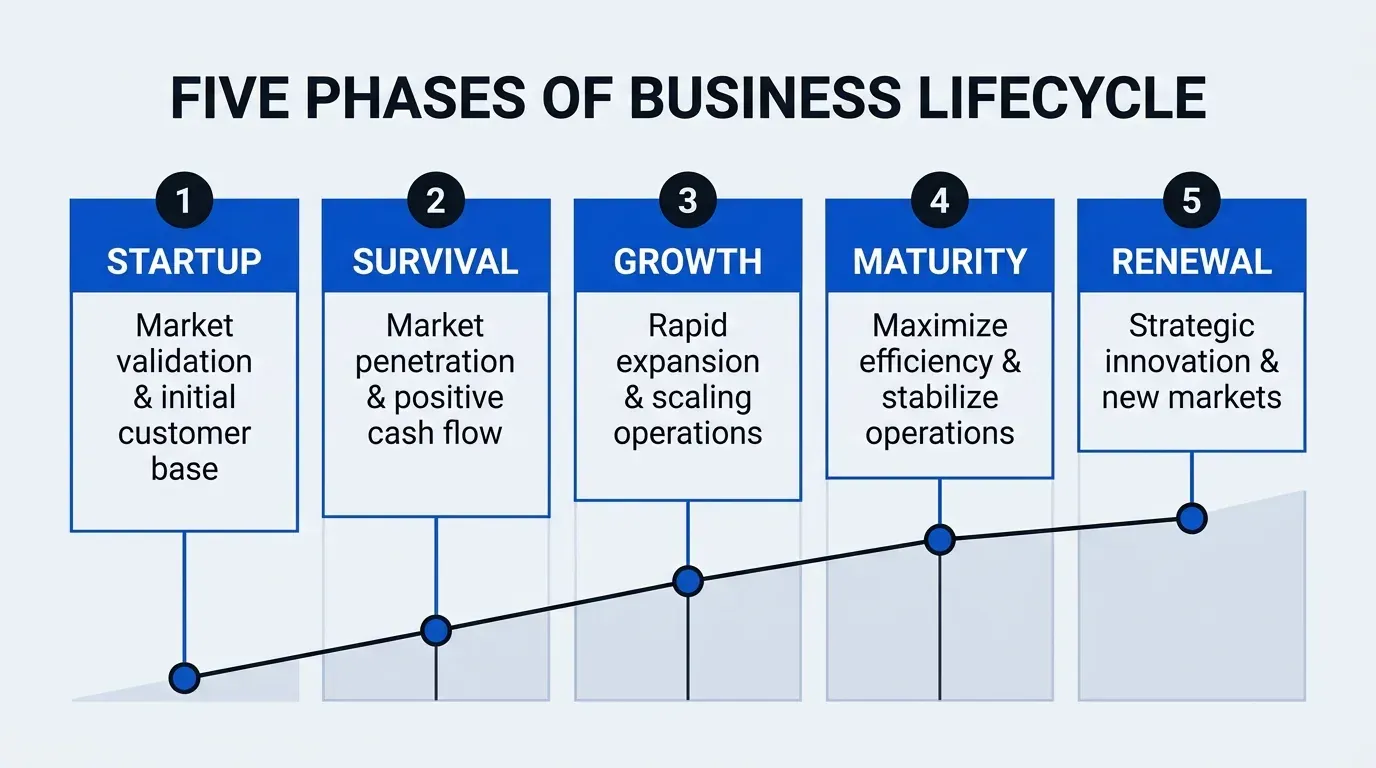
- 1. Start-Up (Existence)Validate product-market fit and secure initial cash runway.
- 2. SurvivalReach break-even and establish predictable cash flow.
- 3. Growth & ScaleStandardize operations, delegate, and expand capacity.
- 4. MaturityMaximize efficiency, defend market share, and systematize.
- 5. Renewal or DeclineInnovate and pivot offerings to avoid stagnation.
Each phase demands different leadership focus, operational structure, and capital allocation.
Phase 1: Start-Up (Existence)
This initial stage is about bringing a business idea to life, acquiring the first customers, validating the product or service, and setting up basic operations. Most often, the business is managed solely by the founder(s), who do everything from sales to delivery.
Top Challenges:
- Attracting and keeping first customers
- Securing funding and managing cash flow
- Fine-tuning product-market fit
- Handling overwhelming workloads with limited resources
Key Questions:
- How do I get my first paying customers?
- Am I solving a problem people care about?
- How can I manage expenses before revenue stabilizes?
Anecdote: Jenna opened a custom cookie bakery with a small loan. Initial foot traffic was slow, so she started sampling outside and engaging local corporate offices. Soon, catering orders picked up, stabilizing early operations.
Phase 2: Survival
The business has overcome initial start-up hurdles and has steady customers. The focus shifts to breaking even and generating positive, predictable cash flow.
Top Challenges:
- Maintaining cash flow and consistently meeting payroll
- Balancing investment in growth against the risk of overextending
- Preventing founder burnout from handling every operational detail
Key Questions:
- Can the business reliably cover operating expenses each month?
- Should profits be reinvested in growth or kept as cash reserves?
- What processes can be delegated immediately?
Anecdote: Larry's lawn care business had steady clients, but late payments almost caused missed payroll. Larry restructured payment terms, built a 90-day cash reserve, and installed automated billing reminders to eliminate cash-flow volatility.
Phase 3: Growth & Scaling
With a stable operation, the business aims to scale: expanding the customer base, hiring specialists, and potentially opening new channels or locations.
Top Challenges:
- Managing rapid increases in demand without quality slipping
- Hiring, onboarding, and retaining key personnel
- Systematizing processes and implementing software tooling
- Securing working capital for expansion
Key Questions:
- How do we scale operations while maintaining customer satisfaction?
- What software systems and team members are required to handle 3x volume?
- How do we keep existing clients happy while pursuing new accounts?
Anecdote: Susan's boutique was overwhelmed by order volume, leading to shipping errors. She documented workflows, hired two assistants, and implemented an integrated inventory management system, unlocking 50% growth without founder burnout.
Phase 4: Maturity
The business is profitable, stable, and enjoys brand recognition. The primary objectives become maintaining market position, optimizing for efficiency, and avoiding stagnation.
Top Challenges:
- Fending off emerging competitors and remaining relevant
- Avoiding organizational complacency and process calcification
- Continuously innovating to keep customers engaged
- Establishing succession planning and executive delegation
Key Questions:
- How do we keep the team agile and innovative?
- What operational efficiencies can increase net margins?
- Are we developing new service lines before market demand shifts?
Anecdote: Angelo's family restaurant noticed a gradual decline in younger diners. Rather than accepting the trend, Angelo modernized the menu with local collaborations and launched a digital loyalty program, defending his market share against new chains.
Phase 5: Renewal or Decline
Every mature business reaches a crossroads: either reinvent itself to capture new growth cycles (renewal) or face shrinking margins and obsolescence (decline).
Top Challenges:
- Recognizing when legacy offerings must be pivoted
- Managing organizational change without compromising core strengths
- Allocating capital toward new initiatives while trimming legacy drag
Key Questions:
- Do we pivot offerings, expand into adjacent markets, or plan an exit?
- What technological or industry shifts can we capitalize on?
- How do we lead our team through strategic transformation?
Anecdote: An outdoor gear store saw retail sales drop due to e-commerce. The owner transformed the shop into an experiential adventure hub with guided weekend workshops and an online club, returning to double-digit growth.
Quick Self-Assessment: Where Do You Stand?
Start-Up / Existence
Your primary bottleneck is customer validation and finding repeatable sales. Prioritize cash preservation and direct customer interviews.
Survival
Your primary bottleneck is working capital and billing predictability. Prioritize cash reserves, payment terms, and basic delegation.
Growth & Scale
Your primary bottleneck is operational capacity. Prioritize software tooling, SOP documentation, and core team hiring.
Maturity & Renewal
Your primary bottleneck is market complacency. Prioritize efficiency audits, strategic reinvention, and high-margin service lines.
Wondering how to move your business to the next phase?
Each phase requires a fundamentally different operational, technology, and growth strategy. Get an objective assessment of your current stage and a clear roadmap for what to execute next.